Counter Espionage Services Malaysia: TSCM Sweeps
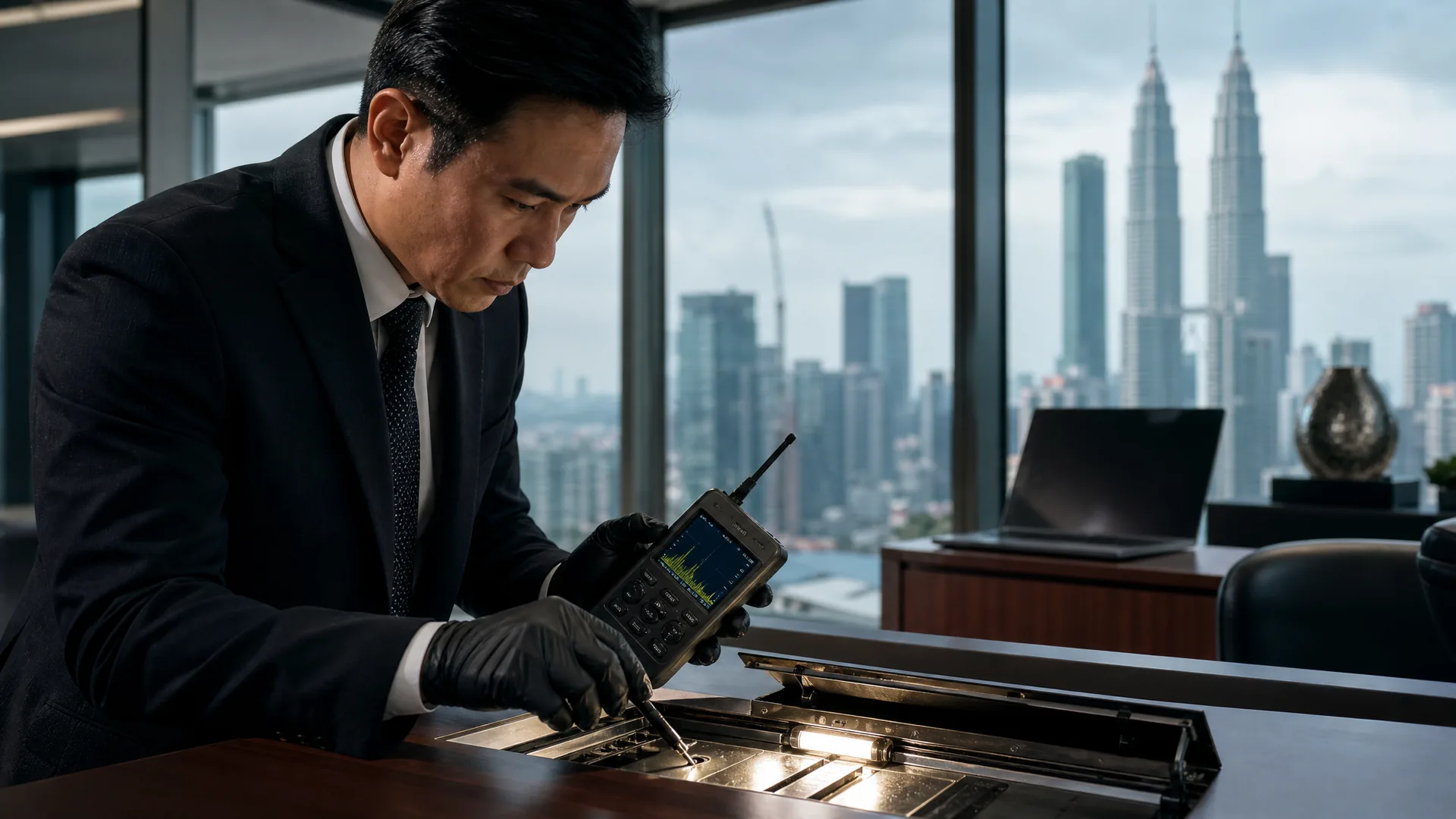
Counter espionage services Malaysia represent one of the most specialised, and most frequently overlooked, layers of corporate security. Organisations invest heavily in IT firewalls and physical access control. Meanwhile, covert listening devices, concealed cameras, and signal-interception equipment planted inside meeting rooms and executive offices remain a growing and largely unaddressed threat. Gunma Detective Agency has operated since 1999 and holds a licence issued by Malaysia's Ministry of Home Affairs, making it one of the longest-established licensed PI firms in the country with verified authority to conduct technical surveillance countermeasures investigations. This page sets out exactly what TSCM involves, who needs it, and how Gunma delivers it, discreetly, professionally, and with full legal standing.
Why Corporate Espionage Is a Growing Threat in Malaysia
Malaysia sits at the centre of Southeast Asia's most active trade and investment corridors. Kuala Lumpur functions as a regional headquarters hub for multinationals across financial services, technology, energy, and manufacturing, all sectors that regional intelligence bodies and law enforcement agencies consistently identify as the most targeted by commercial espionage.
Corporate espionage and trade secret theft are among the fastest-growing white-collar crime categories across Southeast Asia. The Royal Malaysia Police (PDRM) Commercial Crime Investigation Department records year-on-year increases in cases involving the unauthorised acquisition of proprietary business information. INTERPOL's regional threat assessments point to the same pattern. The risk is not theoretical; it is an operational reality for any organisation conducting sensitive commercial activity in the region.
The High-Value Targets: Boardrooms, Deal Rooms, and Executive Suites
Not every office carries equal risk. Threat actors, whether competitors, hostile insiders, or foreign state-affiliated actors, concentrate effort where commercially sensitive conversations take place. Boardrooms used for strategic planning, deal rooms hosting merger negotiations, executive suites where product development decisions are made, and hotel conference facilities used for cross-border transactions are the environments most frequently targeted.
The risk window is specific. Security professionals with backgrounds in law enforcement consistently note that covert listening devices are most commonly planted during periods of staff turnover, office renovation, or high-value negotiation, precisely the windows when a TSCM sweep delivers the highest risk reduction. Organisations approaching a major transaction, a board election, or a significant regulatory submission should treat those periods as elevated-risk phases requiring active countermeasures.
What Are Counter Espionage Services and TSCM in Malaysia?
Counter espionage services Malaysia encompass the full range of technical and investigative measures used to detect, neutralise, and prevent covert surveillance. The discipline is distinct from cybersecurity: where cybersecurity professionals defend digital networks and endpoints, TSCM practitioners address the physical and radio-frequency threat, devices that capture conversations, images, or data from within a room, regardless of the target's IT defences.
Technical Surveillance Countermeasures (TSCM) Explained
Technical surveillance countermeasures, TSCM, is the professional practice of inspecting an environment for unauthorised surveillance equipment. A certified TSCM sweep addresses:
- Radio-frequency (RF) threats: transmitting bugs, GSM-based devices, and Wi-Fi-enabled covert cameras that broadcast captured audio or video externally.
- Hardwired threats: devices connected directly to power or telephone infrastructure, which produce no RF signature and require physical inspection to detect.
- Optical threats: pinhole cameras concealed in everyday objects, smoke detectors, power sockets, or decorative fixtures.
- Network-attached threats: devices that exploit existing LAN or Wi-Fi infrastructure to exfiltrate data, a category that sits at the boundary between TSCM and network security.
TSCM is not a product or an app. It is a professional service requiring certified equipment operated by trained practitioners who understand both the technology and the adversarial tradecraft used to evade detection.
How Bug Sweep Services Work: A Step-by-Step Methodology
A professional bug sweep in Malaysia follows a structured protocol:
- Pre-sweep intelligence gathering. Gunma's team reviews the site layout, access history, recent renovation or maintenance activity, and any indicators of compromise before entering the target environment.
- RF spectrum analysis. Calibrated spectrum analysers scan all frequency bands in use, from sub-GHz through to microwave ranges, to identify transmissions that should not be present. Any anomalous signal is logged, characterised, and traced to its source.
- Non-linear junction detection (NLJD). An NLJD instrument detects semiconductor components, the electronic heart of any covert device, even when the device is switched off or shielded. This is critical for finding dormant bugs that only activate during meetings.
- Physical inspection. Every fixture, fitting, furnishing, power socket, smoke detector, clock, and structural cavity accessible within the sweep zone is physically examined. This step requires experience: knowing where devices are typically concealed is as important as the technical equipment used to find them.
- Telephone and data infrastructure inspection. Wired lines, junction boxes, and network ports are inspected for unauthorised attachments or line-tap equipment.
- Documentation and reporting. All findings, positive or negative, are recorded with photographic and technical evidence to an evidence-grade standard suitable for legal proceedings if required.
Corporate Use Cases: Who Needs Office Bug Detection in KL?
The client profile for office bug detection KL is broader than many organisations assume. Gunma advises clients across legal, financial, corporate, and government-adjacent sectors.
Pre-Meeting and Boardroom Sweeps
A multinational law firm conducting a sensitive cross-border M&A transaction in Kuala Lumpur may commission a pre-meeting sweep of its conference suite and the client's boardroom before any commercially sensitive discussions take place, a scenario Gunma's team is equipped to support on short notice. Similar mandates arise for:
- Annual General Meetings and Extraordinary General Meetings where contested resolutions or activist shareholder activity is anticipated.
- Due diligence data rooms hosting confidential financial and legal documentation.
- Law firm and accountancy conference suites used for privileged client meetings.
- Executive residences and chauffeured vehicles where senior leadership conduct informal strategic discussions.
- Hotel suites and meeting rooms in the Klang Valley and other major Malaysian business centres used for negotiations with external parties.
For organisations pursuing corporate due diligence investigations in Malaysia, a pre-meeting TSCM sweep is a natural and often essential component of the overall mandate.
Ongoing Counter-Intelligence for High-Risk Industries
Some organisations require counter-intelligence services not as a one-time event but as a programme. High-risk industry categories include:
- Technology and IP-intensive companies protecting product roadmaps, source code, or clinical data.
- Financial services firms handling market-sensitive information subject to regulatory confidentiality obligations.
- Energy and extractive industries where concession negotiations and tender strategies represent material commercial value.
- Legal and professional services firms whose privileged communications are themselves a target.
For these clients, employee and partner background checks combined with periodic TSCM sweeps form a coherent, layered counter-intelligence posture, addressing both the human and the technical attack surface.
Gunma's Counter Espionage Investigation Process
Gunma approaches every counter espionage engagement with the same institutional rigour it applies to litigation-grade investigations. The engagement model is designed to be low-friction for the client and watertight in terms of confidentiality.
From Initial Enquiry to Confidential Report
Initial enquiry. Contact with Gunma's team is handled with absolute discretion. Details of the enquiry, including the client's identity, the location, and the nature of the concern, are treated as confidential from the first contact. No information is shared with third parties under any circumstances.
Site assessment. Before equipment is deployed, Gunma conducts a discreet preliminary assessment of the target environment. This confirms scope, identifies access requirements, and allows the team to plan the sweep without alerting potential threat actors.
Sweep deployment. Certified TSCM equipment is deployed by operatives with backgrounds in security operations and law enforcement. The sweep follows the methodology described above, covering RF, NLJD, physical, and infrastructure inspection as appropriate to the environment.
Discovery protocol. When a device is found, Gunma does not immediately remove it. The discovery is documented to an evidence-grade standard, photographed in situ, characterised technically, and recorded in the chain of custody. The client is then advised on options: neutralisation, monitoring, or preservation for legal proceedings. This distinction matters if the client intends to pursue criminal or civil action.
Confidential report. Gunma delivers a written findings report covering all areas inspected, any devices or anomalies detected, technical characterisation of findings, and remediation recommendations. The report is formatted to serve both internal governance purposes and, where required, as supporting evidence in legal proceedings.
Gunma's multidisciplinary team combines expertise in law, accounting, and security operations, an unusually broad capability set that allows counter-espionage findings to be contextualised within a wider corporate due diligence or legal evidence framework rather than treated as a purely technical event.
To verify a licensed private investigator in Malaysia and confirm Gunma's regulatory standing, clients are encouraged to review the agency's Ministry of Home Affairs licensing credentials independently. Operating since 1999 with more than 25 years of continuous practice, Gunma's record is verifiable.
Counter-Intelligence Services Across Southeast Asia
Corporate espionage does not respect borders, and neither does Gunma's operational reach. Kuala Lumpur and the Klang Valley are the agency's primary base. Gunma also supports counter-intelligence mandates across Southeast Asia, including Singapore, Indonesia, Thailand, and other jurisdictions within the region.
For multinationals with regional headquarters in Malaysia and operational presence across multiple Southeast Asian markets, this cross-border capability is material. A single coordinated TSCM programme can address exposure across regional offices, reducing the fragmentation and confidentiality risk that comes from engaging multiple local providers in each jurisdiction.
Gunma's physical surveillance services in Kuala Lumpur extend naturally into the counter-espionage framework, organisations concerned about physical surveillance of their personnel can address both the internal (electronic) and external (physical) threat vectors through a coordinated mandate.
Regional engagements are scoped and costed individually. Clients with multi-jurisdiction requirements are advised to raise this during the initial consultation so that deployment logistics, local legal considerations, and sweep scheduling can be structured accordingly.
Protecting Your Organisation: Next Steps
Selecting a counter espionage firm in Malaysia requires more than a keyword search. The criteria that matter are straightforward: verified licensing under Malaysian law, a transparent and documented methodology, demonstrated capacity for confidential handling, and a track record that can be assessed. Gunma meets each criterion, licensed by the Ministry of Home Affairs, operational since 1999, and equipped with certified TSCM instrumentation operated by experienced practitioners.
The risk profile facing Malaysian and regional organisations in 2026 makes periodic TSCM sweeps a prudent standard of care, not an exceptional measure. Boardrooms, deal rooms, and executive environments where commercially sensitive discussions take place are legitimate targets for threat actors with the means and motivation to act.
Gunma invites corporate decision-makers, legal counsel, and compliance officers to request a confidential, no-obligation consultation. Our team will assess your exposure, outline an appropriate sweep scope, and advise on a programme that matches your operational risk profile, all handled with the discretion and confidentiality that sensitive matters demand. Contact Gunma's team directly to arrange a discreet preliminary discussion.