Cybersecurity Investigation Services for Malaysian Businesses
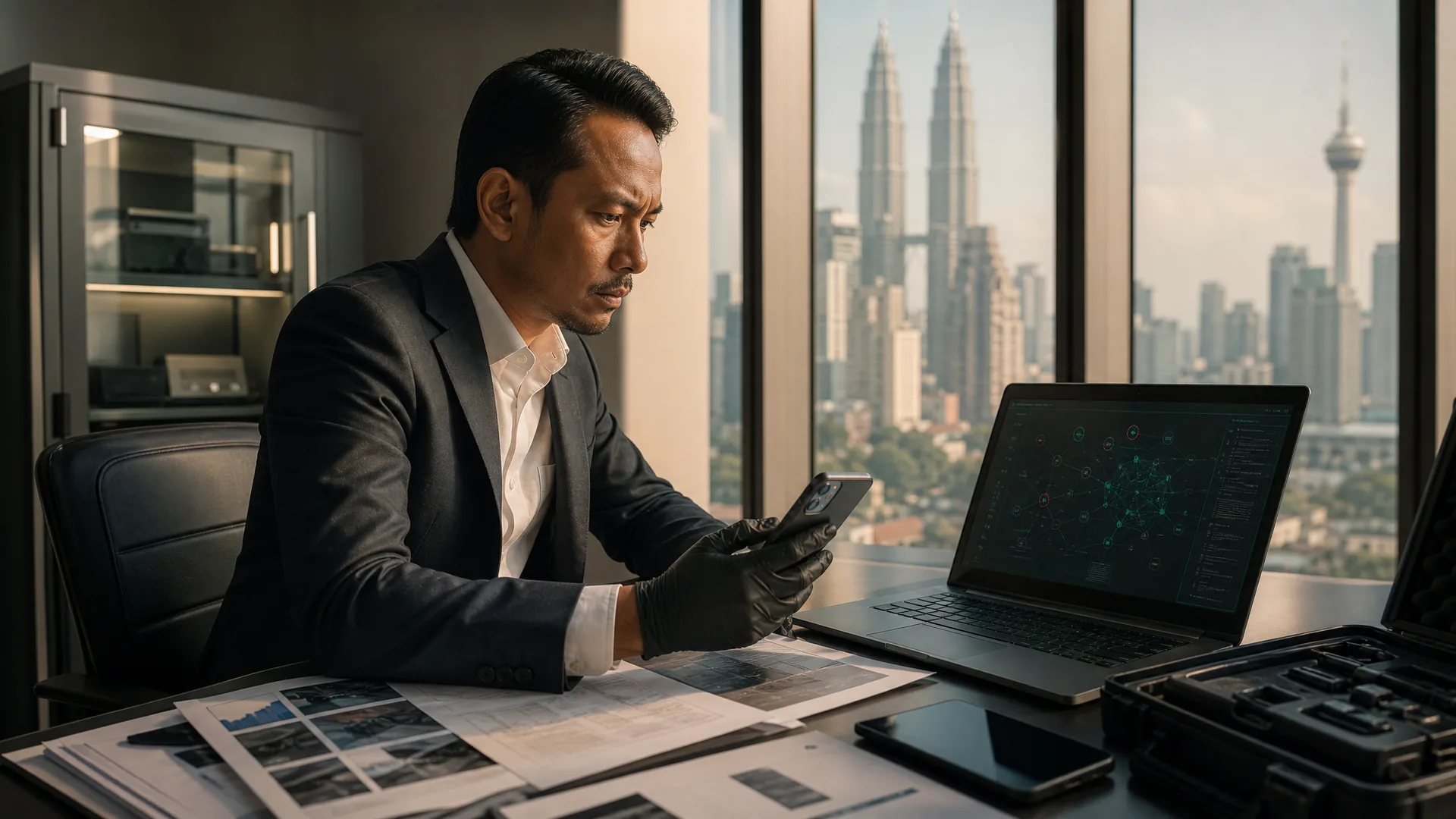
A ransomware alert or a suspicious wire transfer usually starts the same way. The IT team contains the intrusion, resets credentials, and closes the ticket. But containment isn't the same as knowing who did it, why, and whether the evidence will hold up in court. That gap is where a cybersecurity investigation firm in Malaysia does work that a technical security vendor isn't built to do.
This distinction matters more each year as Malaysian companies digitize finance, logistics, and retail operations. A cyber incident investigation in Malaysia now often sits at the intersection of network forensics, employment law, and criminal procedure. Getting that intersection wrong can mean losing evidence, tipping off a suspect, or missing the window to recover stolen funds.
Why Malaysian Businesses Need a Cybersecurity Investigation Firm, Not Just IT Support
IT security teams and managed security providers are built for detection and remediation. They watch for anomalies, patch vulnerabilities, and restore systems after an attack. That work matters, but it stops at the technical boundary of the network.
It doesn't answer who inside the company clicked the link, shared the password, or exfiltrated the files. It doesn't preserve evidence in a form a Malaysian court will accept. And it rarely extends to coordinating with the Royal Malaysia Police or with regulators handling a Personal Data Protection Act complaint.
Pure-play IT security vendors contain and remediate technical intrusions. They rarely trace human intent, build a chain-of-custody evidence file, or liaise with the Royal Malaysia Police and PDPA-related bodies. That is the point where a licensed investigative firm becomes essential.
Where IT Security Ends and Investigation Begins
A firewall log can show that data left the network. It can't tell you whether an employee sold it deliberately or a compromised account was used without that person's knowledge. Answering that question needs human-source work: interviews, background checks, financial tracing, and surveillance where warranted.
This is the natural boundary between IT security and investigation. One side manages systems. The other manages people, motive, and evidence that can survive legal scrutiny.
Core Cyber Incident Investigation Services in Malaysia
A cybersecurity investigation firm typically works alongside a company's existing IT or security operations centre, not in place of it. The investigative team steps in once the technical response has stabilised the environment, when the harder questions about cause, intent, and accountability remain open.
Corporate clients across finance, logistics, and retail bring in this kind of support most often. These industries handle sensitive customer data and high transaction volumes, which makes them frequent targets for both external attackers and insiders looking for financial gain.
Data Breach Investigation and Root-Cause Tracing
A data breach investigation in Malaysia usually begins with scoping: what was accessed, when, and by which account or device. Investigators work with forensic images of affected systems to reconstruct the timeline of the intrusion.
From there, the focus shifts to exfiltration tracing. That means following the path data took out of the network, whether through cloud storage, email, or removable media. This step determines whether the breach was opportunistic or targeted, and whether it involved someone with legitimate internal access.
Insider Threat Investigation in Kuala Lumpur
Insider cases carry particular risk. A wrong move can alert the suspect and destroy evidence. An insider threat investigation in Kuala Lumpur typically runs quietly, using access logs, financial records, and discreet interviews before anyone inside the company is confronted.
Investigators cross-reference system activity with HR records, financial disclosures, and communication patterns. This builds a factual picture before any confrontation, which protects both the company and the employee from a premature or unsupported accusation.
IT Forensics Malaysia: From Digital Evidence to Legal Admissibility
Collecting digital evidence only helps if that evidence can later be relied on. IT forensics in Malaysia follows established handling standards so findings survive challenge in a disciplinary hearing, a civil claim, or a criminal proceeding.
That means forensic imaging of devices rather than working from live copies, cryptographic hashing to prove data hasn't been altered, and detailed logs of everyone who touched the evidence. For a deeper look at how these standards apply locally, see this article on the legal standards for digital forensics in Malaysia.
Chain of Custody and Evidence Standards
Chain of custody documentation records exactly who collected each piece of evidence, when, and how it was stored afterward. Any gap in that record gives an opposing lawyer grounds to question whether the evidence was tampered with.
A properly maintained chain of custody separates evidence a court will accept from information that's merely useful internally. This is a core discipline of forensic investigation work, not an afterthought added at the reporting stage.
Handoff to Law Enforcement and Regulators
Once an investigation identifies a likely cause and responsible party, the findings often need to move beyond the company. That could mean a formal report to the Royal Malaysia Police, a PDPA-related complaint to the relevant regulator, or a package of evidence prepared for civil litigation.
A licensed investigative firm packages findings in the format these bodies expect, with supporting documentation attached. Many purely technical incident responses stall at this step, because remediation teams aren't set up to prepare law-enforcement-ready reports.
Cyber Crime Investigation Malaysia: Common Scenarios We Handle
Cyber crime investigation in Malaysia covers a range of scenarios beyond a single "hacking" incident. Most cases fall into a handful of recurring patterns, each requiring a slightly different investigative approach.
Business Email Compromise and Financial Fraud
Business email compromise remains one of the most damaging categories of cyber-enabled fraud. A finance team receives what looks like a legitimate payment instruction from a supplier or executive, and the funds move before anyone questions it.
Consider a manufacturing client whose finance department suffers a business email compromise. IT flags the intrusion, but it can't determine which employee's credentials were the entry point, or whether data was exfiltrated for insider gain. That gap is where digital forensics needs to pair with human-source investigation.
Insider-linked incidents and business email compromise consistently rank among the costliest categories of corporate cyber loss worldwide. Malaysian firms report similar exposure as digital adoption accelerates across finance, logistics, and retail. These cases often connect to wider financial fraud patterns covered under broader fraud investigation services.
Cyberbullying, Harassment, and Reputational Attacks
Not every cyber-enabled case involves stolen funds. Executives and staff increasingly face targeted harassment, doxxing, or coordinated reputational attacks online, sometimes from a disgruntled employee or competitor.
These cases require tracing anonymous accounts back to real individuals. That takes a mix of technical tracing and traditional investigative legwork. A dedicated look at handling these situations is available through Gunma's cyberbullying investigation services. Some of these cases also intersect with physical monitoring concerns, which is where spyware detection beyond antivirus scans becomes relevant for executives who suspect they're being tracked as well as harassed.
Choosing a Cybersecurity PI in Malaysia: Licensing, Confidentiality, and Process
Not every provider offering "cyber investigation" services in Malaysia is a licensed investigative firm. Some are IT consultancies using investigation as a marketing term, without the legal standing or training to back it up.
What to Verify Before Engaging an Investigator
Before engaging a cybersecurity PI in Malaysia, a business should confirm the firm's licensing status with the relevant authority, ask about its confidentiality practices, and check that its team includes people trained in evidence handling, not only technical remediation.
Gunma Detective Agency has operated as a licensed private investigation firm since 1999, certified by Malaysia's Ministry of Home Affairs. Its team spans law, accounting, and security disciplines, which supports the multidisciplinary nature of cyber-incident work. Whether it's legal to hire a private investigator in Malaysia is a common early question for businesses, and it's addressed directly in a dedicated article linked here: whether it's legal to hire a private investigator in Malaysia.
Deciding when to involve law enforcement versus a private investigator first depends on the stage of the case. If funds are still moving, or a crime is actively in progress, police involvement shouldn't wait. But if the company needs to first establish facts quietly, without alerting a suspected insider, an investigation firm is often the right starting point. Law enforcement can be brought in once evidence is secured.
How a Typical Engagement Unfolds
A typical engagement follows a consistent sequence. First, a confidential intake call establishes the scope of the suspected incident and any immediate risks. Second, investigators scope the affected systems and secure forensic images before anything further is altered.
Third, the team runs parallel tracks: technical evidence tracing and, where insider involvement is suspected, discreet human-source work. Fourth, the team compiles findings into a report structured for the intended audience, whether that's internal management, the police, or a court. Fifth, the firm advises on next steps, which may include a handoff to regulators or support through compliance investigation services for corporates.
For companies concerned that a cyber intrusion may be paired with physical surveillance or bugging, this process can extend to counter-espionage and TSCM sweeps. Many clients also engage this work as part of a wider mandate under corporate investigation services, particularly when a cyber incident intersects with broader questions about employee conduct or third-party risk.
A suspected breach, an unexplained fund transfer, or signs of an internal leak all warrant the same first step: a confidential conversation before evidence is disturbed further. Businesses facing any of these situations can request a confidential consultation with Gunma's cybersecurity investigation team to secure evidence properly and move toward a legally sound resolution.