Private Investigator in Southeast Asia
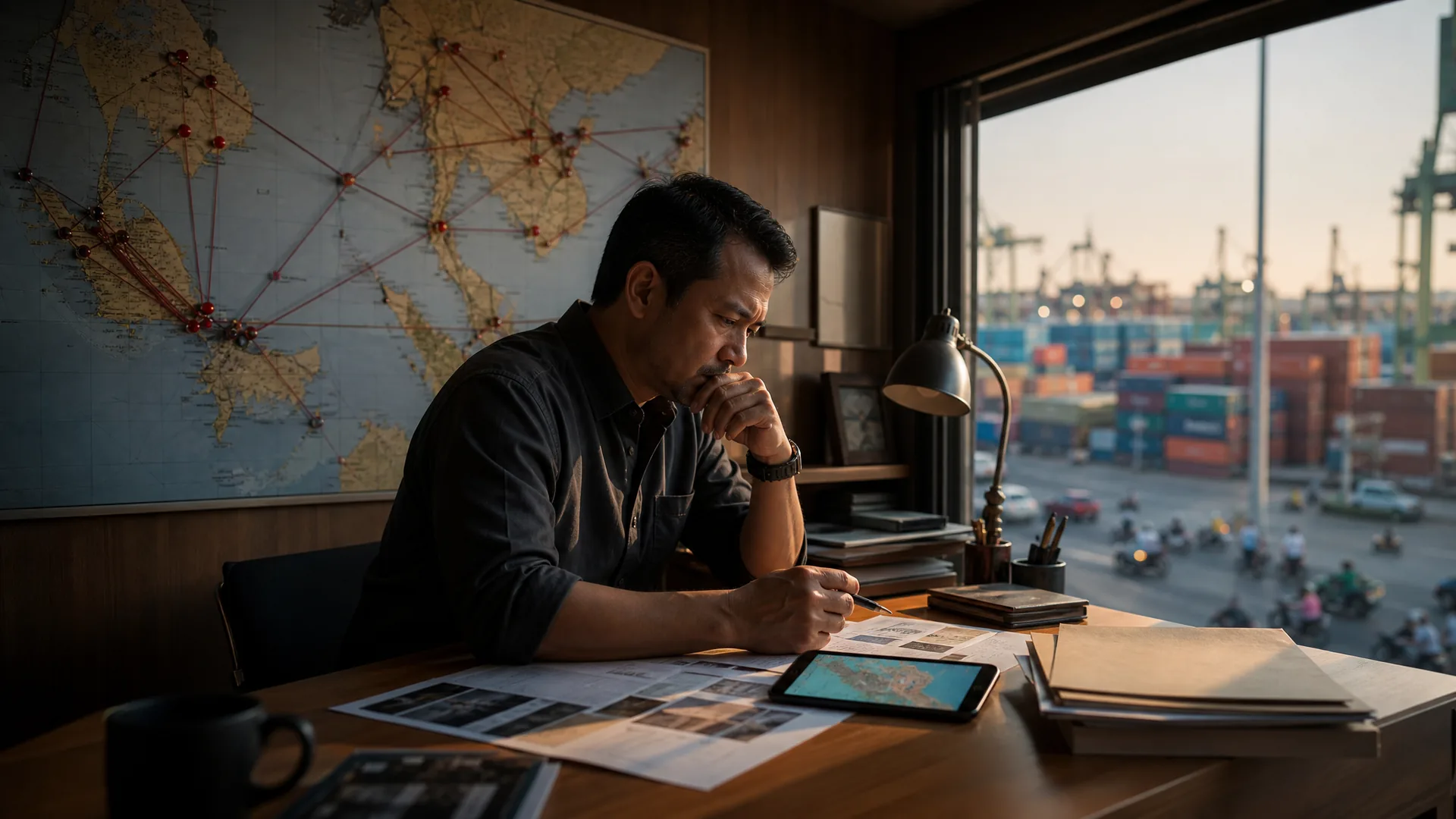
A multinational company facing a supply-chain fraud case rarely has the problem contained to one country. A supplier issue in Malaysia can connect to a shell company in Singapore, a shipment discrepancy in Thailand, or a missing employee in Indonesia. Handling each thread through a separate local firm wastes time. It also creates gaps in the evidence trail. This is the gap a regional private investigator in Southeast Asia is built to close, and it's the focus of this guide.
Why Multinational Clients Need a Regional Private Investigator in Southeast Asia
Corporate legal and compliance teams increasingly work across more than one Southeast Asian jurisdiction at a time. A due diligence check on a new supplier might touch Malaysia and Vietnam in the same week. A fraud investigation might need evidence from Singapore and Thailand before it reaches a courtroom or a boardroom. Coordinating that work through several disconnected local agencies slows everything down and adds risk at every handoff.
A single PI agency in Southeast Asia with genuine cross-border capability removes that friction. One point of contact manages the case. One reporting standard applies across countries. One team stays accountable for the full engagement, not just its local slice.
The Limits of Locally-Focused PI Agencies
Most investigation firms in the region market to a single city or country. That's a reasonable model for a landlord checking a tenant, or a family tracing a missing relative nearby. It breaks down for a multinational client whose case doesn't respect borders.
A locally-focused agency may not hold licensing to operate in a neighboring country. It may lack established relationships with legal counsel or law enforcement outside its home market. When a case grows beyond its original city, that agency has to subcontract or refer the client elsewhere. That fragments the investigation, and the evidence chain along with it.
Legal Frameworks for Private Investigators Across Malaysia, Singapore, Thailand, and Indonesia
Southeast Asia is not one legal system. Each country regulates private investigation differently. A firm operating across the region has to understand each framework, not assume that clearance in one country carries over to another.
Licensing and Regulatory Differences by Country
In Malaysia, private investigators typically operate under licensing tied to the Ministry of Home Affairs, alongside registration requirements for the agency itself. Singapore regulates private investigation activity through its own licensing authority, with rules on surveillance conduct and data handling. Thailand and Indonesia apply their own registration and permitted-activity rules, and enforcement practice varies by jurisdiction.
The practical point for a corporate client: don't assume a license valid in one country lets an investigator operate legally in another. A firm that genuinely covers the region maintains separate licensing and standing in each market it serves, rather than sending one team across borders to work under a single credential.
Evidence Admissibility Across Borders
Evidence gathered in one country doesn't automatically hold up in another jurisdiction's court, or even in a compliance file prepared for a head office overseas. Cross-border cases succeed or fail largely on legal admissibility. Evidence collected without regard to a country's licensing and privacy rules can become unusable, no matter how relevant it is to the underlying case.
This is why chain of custody matters as much as the finding itself. A firm working across Malaysia, Singapore, Thailand, and Indonesia needs to document how it gathered evidence, under which country's law, and by which licensed operator. Readers who want the specifics of how this works in one jurisdiction can review verifying a private investigator's credentials and licensing for a Malaysia-focused breakdown, alongside a dedicated look at digital forensics and legal evidence standards.
Core Services of a Cross-Border Investigation Firm in Southeast Asia
For corporate clients, the work centers on risk: due diligence, fraud checks, background verification, and compliance-oriented investigation. For individuals, cases tend to be personal, involving infidelity, missing family members, or asset tracing tied to a divorce or inheritance dispute. A regional firm handles both. But the corporate side leans harder on documentation, financial scrutiny, and legal defensibility, since findings often feed into a compliance file or a court filing rather than a private decision.
Corporate Due Diligence and Compliance Checks
Due diligence work covers supplier vetting, partner background checks, and fraud investigations tied to mergers, acquisitions, or ongoing vendor relationships. A multinational manufacturer expanding into Vietnam and Thailand may need supplier background checks in one country and counterfeit-goods surveillance in another. A single point of contact can coordinate both, rather than three separate local agencies. That coordination is the practical value a regional investigation firm across Southeast Asia brings to a compliance team.
Southeast Asia's economic integration under frameworks like ASEAN has pushed more multinational firms to run due diligence and fraud checks across two or more member states at once, rather than handling them country by country. For a closer look at how this plays out in one market, see corporate due diligence investigations in Malaysia.
Missing Person Cases That Cross Borders
Missing person cases don't always stay within one country's borders either. A family member may travel for work between Singapore and Malaysia. An employee under investigation may relocate from Thailand to Indonesia. A regional firm can track a case as it moves, rather than handing it off to a new investigator every time it crosses a border. A detailed walkthrough of how this process runs in a single-country case is available in the missing person investigation guide.
Surveillance Techniques and Technology Used in Regional Investigations
Physical surveillance, digital forensics, and intelligence-gathering all get adapted to local conditions. Traffic patterns and urban layout in Kuala Lumpur call for a different surveillance approach than the transit-heavy density of Singapore or the wider spread of greater Jakarta. Legal limits shift too. What counts as permissible covert recording or data access in one country may be restricted in another.
A cross-border investigation firm in Southeast Asia builds its methods around each country's rules rather than applying one playbook everywhere. Digital forensics work, for instance, has to follow the data-privacy and evidence-handling standards of the jurisdiction where the information sits, not just the client's home country. For a concrete example of how field surveillance is run locally, see the surveillance services used in Kuala Lumpur cases.
How to Hire a Licensed Private Investigator for a Southeast Asia-Wide Case
Choosing a firm for a multi-country case is different from hiring a local investigator for a single matter. A few checks up front save significant trouble later.
Questions to Ask Before Engaging a Regional Firm
Confirm licensing in each country the case will touch, not just the firm's home base. Ask whether the team includes professionals beyond field investigators, such as legal, accounting, or security specialists, since corporate cases often need that broader scrutiny. Confirm confidentiality protocols in writing before sharing sensitive company or personal information.
Ask, too, how the firm handles reporting across jurisdictions. A single unified report that documents each country's findings under its own legal standard is far more useful to a compliance team than several disconnected local write-ups. For readers weighing a single-country engagement first, the step-by-step guide to hiring a private investigator walks through the process in more depth.
On cost, a regional or cross-border case typically runs higher than a single-country engagement, since it involves coordinating licensed operators, travel, and legal review across more than one jurisdiction. A firm that can scope and quote this work as one engagement, rather than separate country-by-country invoices, gives a clearer picture of total cost before work begins. A confidential consultation is the most reliable way to get a realistic estimate for a specific case.
Choosing Gunma Detective Agency for Multinational Investigation Services in Asia
Gunma Detective Agency has operated as a licensed investigation firm since 1999, certified by Malaysia's Ministry of Home Affairs, with a track record serving governments, corporations, and law enforcement across Southeast Asia and the Middle East. Over more than two decades, the agency has handled the legal and procedural differences this guide describes, case by case.
Gunma's multidisciplinary team includes professionals with backgrounds in law, accounting, and security, which supports the financial and legal scrutiny multinational due diligence work requires. That combination matters for a private investigator in Singapore, Thailand, or Malaysia asked to produce findings that hold up in a courtroom or a corporate compliance review, not just a private report.
For companies and individuals with cases that cross Southeast Asia's borders, the practical answer is a single firm that already understands each jurisdiction's rules, rather than several vendors learning as they go. Gunma Detective Agency's corporate investigation services cover exactly this kind of multi-country work. Contact the agency for a confidential consultation to discuss a regional or cross-border case spanning Malaysia, Singapore, Thailand, Indonesia, and beyond.